What is SWP?
SIP Builds Wealth. But How Do Mutual Funds Pay You When Your Salary Stops?
Systematic Investment Plans (SIPs) have become one of the most powerful and popular ways to build long-term wealth. They represent discipline, consistency, and the ability to stay invested through market ups and downs. Over time, SIPs help investors accumulate a meaningful corpus and participate in India’s growth story.
But SIPs answer only one part of the investing journey, the accumulation phase. A far more important and often ignored question emerges as investors approach retirement or financial independence.
What happens when the salary stops?
For millions of private-sector employees who do not have a pension, this question is not theoretical. It is deeply personal. Investors may have built substantial wealth through mutual funds, yet they remain unsure how that wealth will support their monthly expenses once regular income ends.
The Question Every Investor Eventually Asks
Mutual Fund Distributors hear this concern repeatedly.
Can mutual funds give me regular income?
How will my investments pay my monthly bills?
What if markets fall exactly when I need money?
Because mutual funds do not pay interest like fixed deposits and dividends are not predictable, many investors assume they will need to move their entire corpus to the bank at retirement. This assumption often leads to suboptimal decisions and lower long-term outcomes. The confusion does not come from lack of wealth, but from lack of clarity.
Fixed deposits have conditioned investors to think in a certain way. Interest gets credited automatically, either monthly or quarterly. The principal remains untouched, and the process feels safe and familiar. Mutual funds operate differently. They do not credit interest. They do not promise fixed payouts. Their value fluctuates with market movements, which can feel uncomfortable when income needs are involved.
This leads to a mental block where investors wonder whether they are forced to redeem their principal, whether markets can disrupt cash flow, and whether mutual funds are even suitable after retirement. This is precisely where a Systematic Withdrawal Plan changes the way investors think about income.
Understanding Systematic Withdrawal Plans (SWP)
A Systematic Withdrawal Plan, or SWP, is a facility that allows investors to withdraw money from their mutual fund investments at regular intervals. The withdrawal can be monthly, quarterly, or annual, depending on the investor’s needs.
Instead of withdrawing the entire corpus at once, SWP converts a lump sum into a steady stream of cash flow. The amount withdrawn is credited directly to the investor’s bank account, much like a salary or pension. The remaining corpus stays invested in the market and continues to grow over time.
SWP Creates Predictable Income
SWP works by redeeming a small portion of mutual fund units periodically. When markets are strong, fewer units are sold. When markets are weak, slightly more units are redeemed. Over time, this naturally averages out the redemption price.
This mechanism allows investors to avoid the stress of market timing. There is no need to decide when to sell or worry about daily market movements. Income flows in automatically, while the portfolio continues to participate in long-term growth. The result is a combination of income stability and continued wealth creation.
SWP for Retirement Planning
One of the biggest advantages of SWP is its simplicity. Once the plan is set up, withdrawals happen automatically without monthly intervention. This brings emotional comfort, especially during volatile markets.
At the same time, SWP offers flexibility. Investors can increase withdrawals to meet rising expenses, reduce them during market downturns, or pause them temporarily if income needs change. This adaptability makes SWP far more practical than rigid income products.
Most importantly, SWP allows investors to enjoy the benefits of compounding even after retirement. Only a part of the corpus is withdrawn, while the rest continues to grow, helping the portfolio last longer.
Tax Efficiency: A Hidden Advantage of SWP
Taxation plays a crucial role in retirement income planning, and SWP is often more tax-efficient than traditional options. In SWP, tax is applicable only on the capital gains portion of each withdrawal. Since withdrawals are staggered over time, the tax impact is spread out and often significantly lower than lump-sum redemptions. For equity mutual funds, long-term capital gains on units held for more than one year are taxed at 12.5%. For debt mutual funds, long-term capital gains apply after two years and are taxed at 12.5%.
In contrast, dividend income from mutual funds or stocks is added to total income and taxed according to the investor’s slab rate. Fixed deposit interest is fully taxable every year, regardless of whether the money is needed or reinvested. From a post-tax income perspective, SWP often delivers superior results.
When and How SWP Works Best
SWP is not meant for short-term needs. It works best when implemented after a long accumulation period, once the portfolio has had sufficient time to grow. The withdrawal rate should ideally be lower than the expected long-term growth rate of the portfolio. This balance is critical for sustainability and longevity of income.
Using online SWP calculators helps investors estimate how long their corpus can last and what withdrawal levels are sustainable. AssetPlus Partners can explore the SWP Calculator available in the AssetPlus Partner App under the Resources section to plan this more accurately.
SWP Illustration
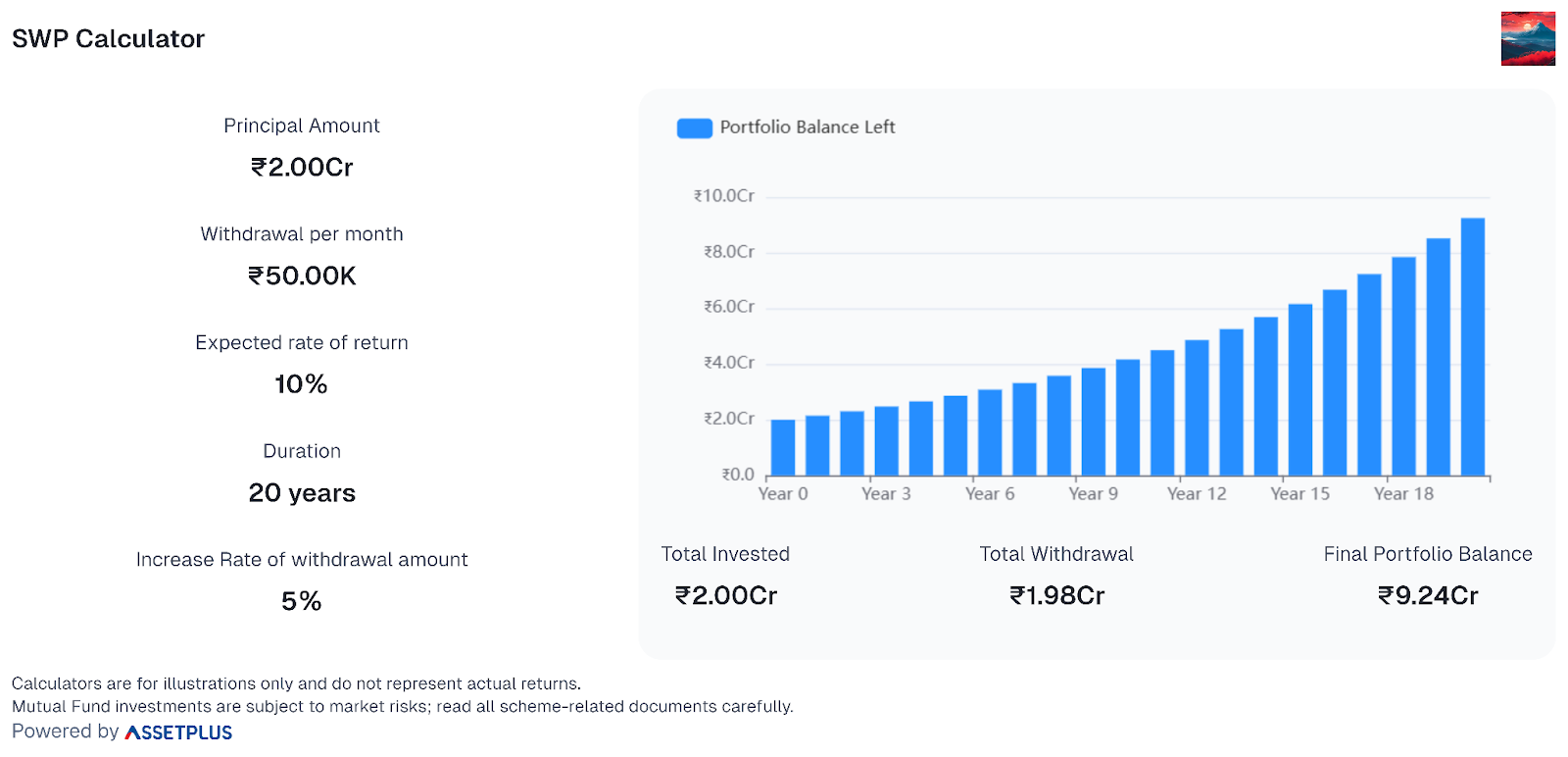
Consider an investor who has accumulated a corpus of ₹2 crore. They decide to withdraw ₹50,000 per month through an SWP, with the withdrawal amount increasing by 5% every year to manage inflation.
Assuming the remaining corpus grows at an average rate of 10% annually, the portfolio continues to support regular withdrawals over a long period without being depleted quickly. While real markets are volatile and returns are never linear, disciplined withdrawals combined with long-term growth can create reliable income without sacrificing the entire corpus.
The Bigger Picture
The true goal of investing is not just to accumulate wealth, but to convert that wealth into lifelong financial security. A well-planned Systematic Withdrawal Plan allows money to keep working for the investor even after regular employment income stops. It bridges the gap between wealth creation and income generation with clarity and confidence.
This is where a skilled Mutual Fund Distributor plays a vital role, helping investors move smoothly from accumulation to distribution. Because real financial success is not measured by how much you build, but by how peacefully your money supports you for the rest of your life.
Related posts
.png)
.png)
.png)
Become a Mutual Fund Distributor
Build a thriving career as a Mutual Fund Distributor with AssetPlus Academy’s expert-led training and mentorship.

