
2025 City-wise AUM Data: What it Means for MFDs
AMFI recently released AAUM (Average Asset Under Management) data for 2025 citywise showcasing AUM concentration, growth patterns, and trends. Here’s a list of top 10 cities AAUM wise.
Key figures from this report indicate:
Indian mutual fund assets remain heavily concentrated in key urban centres, underscoring the continued dominance of financial and commercial hubs in driving investment flows.
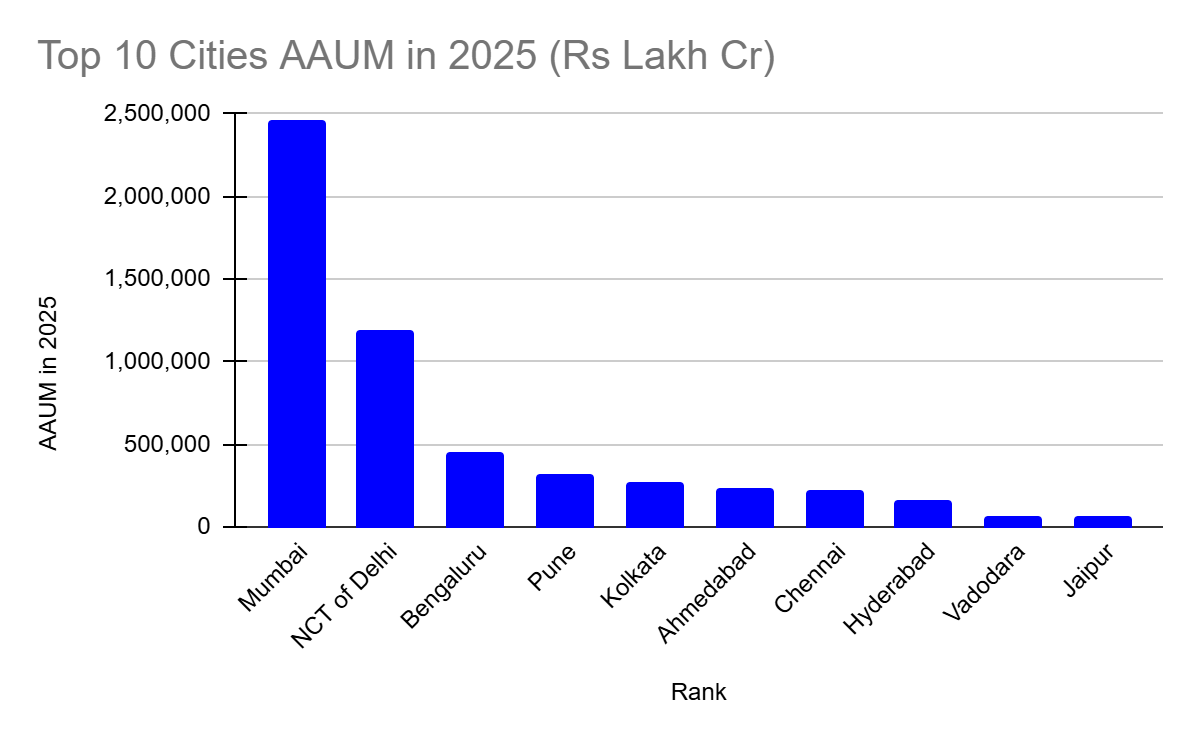
- Mumbai alone accounts for >30% of all mutual fund AUM in India, more than the next two cities combined. The Average AUM in Mumbai jumped 30% in 2025 compared to 2024, indicating rapid mutual fund growth in India’s financial hub.
- NCT of Delhi accounted for close to 14% of total AAUM, recording a whopping 40% growth in 2025.
- South cities Bengaluru, Chennai, Hyderabad, Coimbatore grow steadily, recording double-digit growth in AAUM.
- Kolkata figures in the top 5, holding 3.32% share of the pie and a 13% AAUM growth rate.
- Top 10 cities contribute nearly two-thirds of the industry’s assets, highlighting urban concentration.

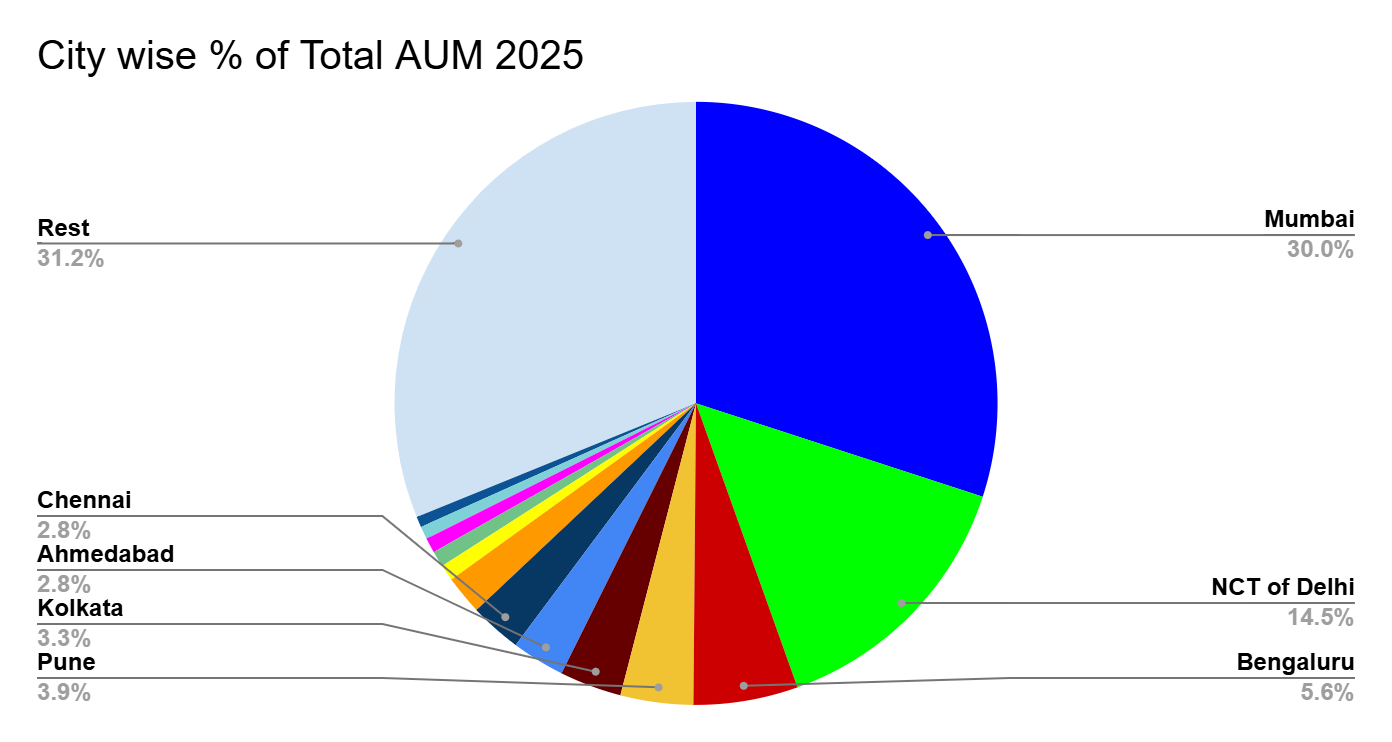
- Top 5 cities cover almost half of the entire AAUM across the country.
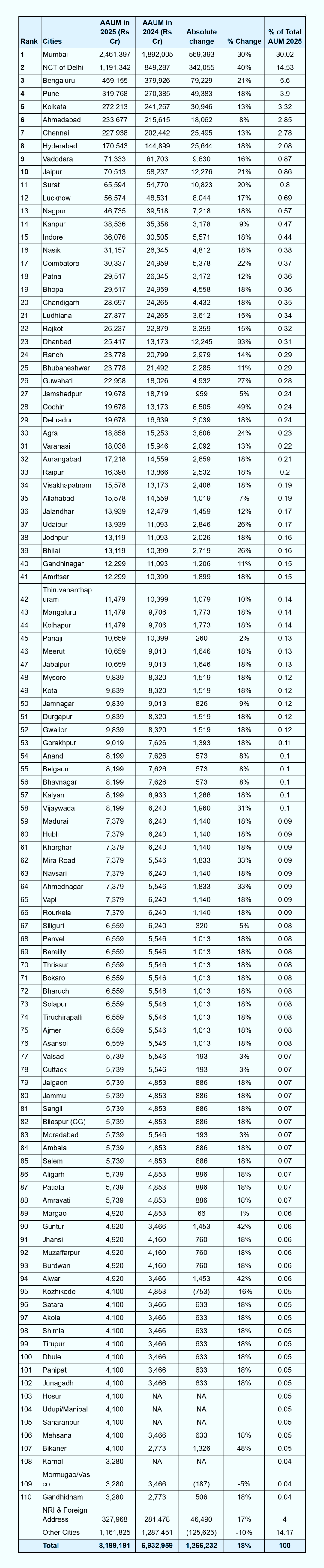
- Cities beyond the top 10 still play a role, with rapid growth seen in locations like Surat, Lucknow, and Nagpur.
- B30 locations such as Dhanbad, Cochin, Bhilai show strong growth.
The table shows the list of Cities with AAUM 2025, growth compared to 2024, and % share in total AAUM:
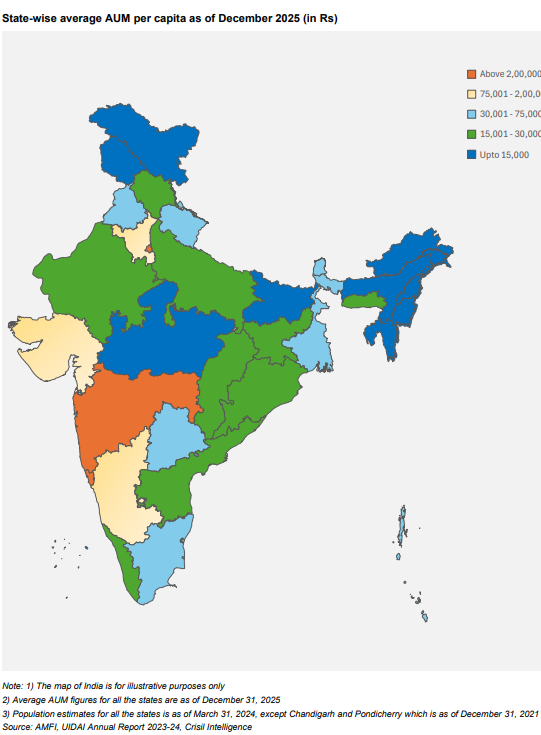
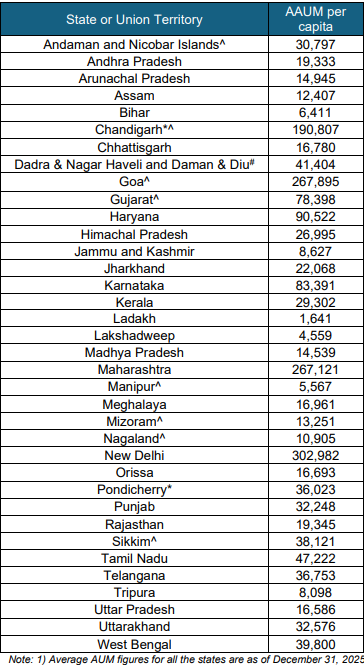
The Average AUM per capita as of Dec 2025
What this Data Means for MFDs
If you’re operating in a non-metro or Tier-II city, you are sitting in an underpenetrated opportunity.
- Growth potential is higher where penetration is lower.
- Competition is lower than in Mumbai or Delhi.
- Investor education will give you massive business upside.
- Here you can position yourself as ‘the local investment specialist’ in your city.
Cities like Ahmedabad, Hyderabad, Jaipur, Vadodara show strong YoY growth. Money is flowing beyond metros as financial awareness expands.
For MFDs:
- First movers will dominate these cities.
- Digital acquisition can accelerate faster here.
- Relationship-driven advisory works better in smaller markets.
- Here you can run SIP awareness drives, investor seminars, and digital campaigns in Tier-II clusters.
If you calculate AUM per capita:
- Mumbai investors allocate much more per person.
- Metros such as Kolkata may be lagging behind Delhi or Mumbai in per capita penetration.
In lower per-capita cities or regions:
- Investors may invest small amounts through SIPs.
- But ticket size will grow with trust, education, and deeper relationships.
- This can be a promising compounding territory for trail income.
The Big Opportunity
India’s MF AUM is growing rapidly. But penetration outside top cities is still low. For serious MFDs, this means: The next ₹50–₹100 Cr AUM opportunity is not in fighting competition. It is in building markets.
Frequently Asked Questions (FAQs)
1. What is AAUM and why is it important for MFDs?
AAUM (Average Assets Under Management) represents the average value of mutual fund assets managed over a period. For Mutual Fund Distributors (MFDs), AAUM determines trail income, business stability, and growth potential.
2. Which city has the highest mutual fund AUM in 2025?
Mumbai leads with 30.02% of total AUM and recorded 30% YoY growth, making it India’s largest mutual fund hub.
3. How did NCT of Delhi perform in 2025?
NCT of Delhi contributed 14.53% of total AAUM and recorded an impressive 40% growth compared to 2024, one of the highest among major cities.
4. Are Tier-II cities growing faster than metros?
Yes. Many Tier-II and B30 cities such as Dhanbad (93%), Cochin (49%), Guwahati (27%), Jaipur (21%), and Surat (20%) are witnessing strong double-digit growth, indicating expanding financial awareness and penetration.
5. What does city-wise AUM concentration indicate?
Top 10 cities contribute nearly two-thirds of India’s mutual fund assets, showing urban concentration. However, rapid growth in smaller cities suggests future decentralization.
6. Why should MFDs focus on non-metro cities?
Non-metro cities offer lower competition, higher growth potential, untapped investor base, strong relationship-driven advisory advantage, and ong-term trail income compounding.
7. What is the significance of per capita AUM?
Per capita AUM shows how much investors allocate on average. Mumbai and Delhi have higher per capita investments, while smaller cities offer growth potential as investor awareness increases.
8. Which cities show strong YoY growth beyond metros?
Cities like Ahmedabad, Hyderabad, Jaipur, Vadodara, Coimbatore, Guwahati, Vijayawada, and Bhilai are showing strong year-on-year growth.
9. What is the opportunity size for MFDs in emerging cities?
With penetration still low outside top metros, building a ₹50–₹100 Cr AUM book is achievable through SIP awareness drives, investor education programs, and digital acquisition strategies.
10. How can MFDs capture growth in Tier-II clusters?
MFDs can conduct SIP awareness campaigns, run investor education seminars, leverage digital marketing and local branding, position as a 'Local Investment Specialist' and Focus on long-term relationship advisory
.png)

.png)
Become a Mutual Fund Distributor
Build a thriving career as a Mutual Fund Distributor with AssetPlus Academy’s expert-led training and mentorship.

