.png)
From Employee to Entrepreneur: Why Finance Professionals Make Great Mutual Fund Distributors
If friends keep asking you "where should I invest?", you've already done the hardest part of this job.
Most people in finance have answered that question more times than they can count. A cousin asking about their first SIP. A colleague worried about retirement. A friend who just got a bonus and has no idea what to do with it. You help, because you can, and because people trust you to.
That instinct to guide people through money decisions is worth a lot. It can also be the start of a business of your own. If you work in finance and you've thought about going independent, take a serious look at mutual fund distribution. Very few businesses let you start with the advantages you already have.
The Mutual Fund Opportunity in India Is Huge
The numbers make the case on their own:
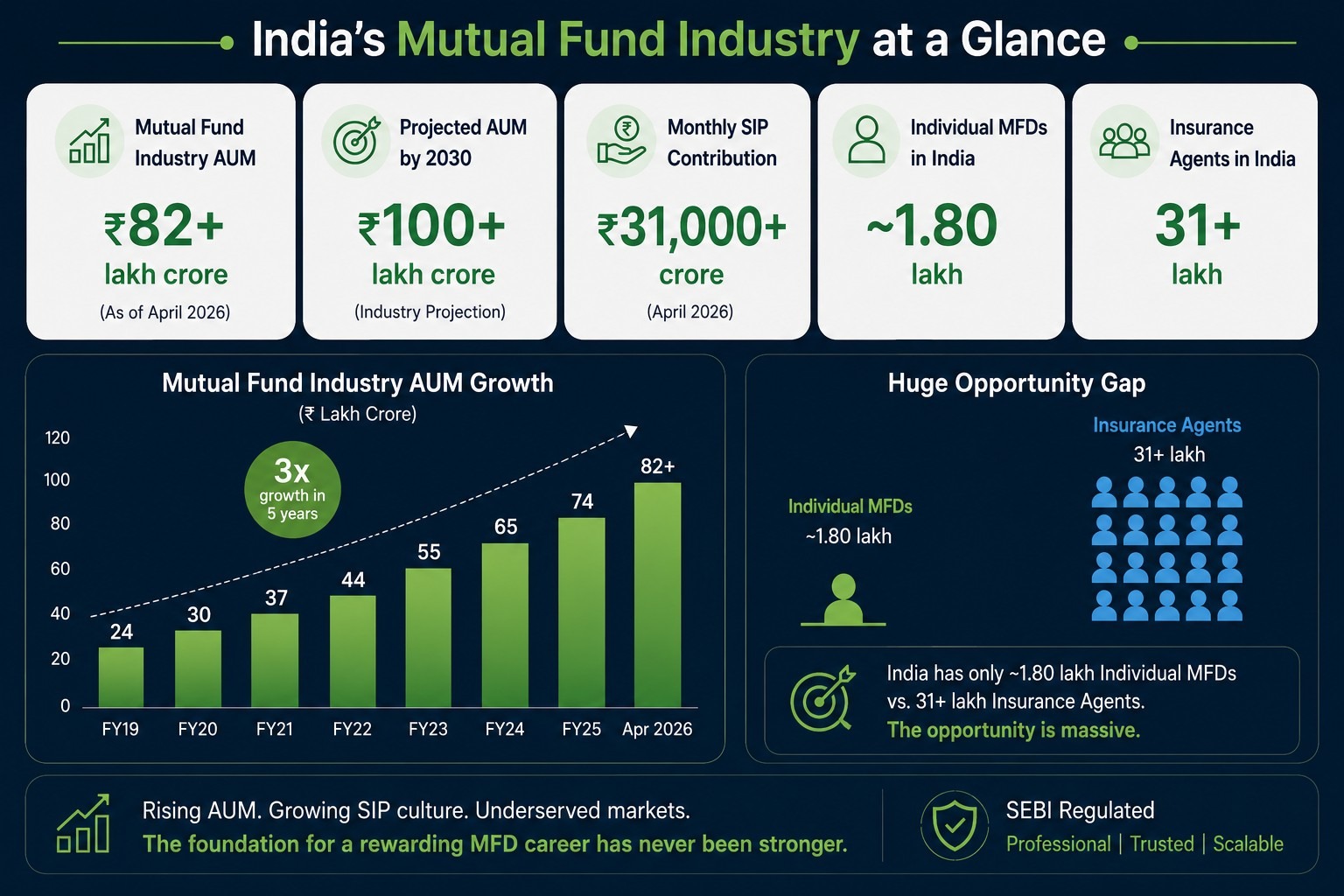
- India's mutual fund AUM has grown almost 6x in ten years, from ₹14 lakh crore in 2016 to ₹81 lakh crore in 2026.
- Monthly SIP inflows recently hit a record ₹32,000 crore.
- There are only about 1.80 lakh individual MFDs for a country of 1.45 billion people.
Mutual fund participation in India is still early. The market is growing fast, and there simply aren't enough qualified people to serve it.
The Field Is Wide Open
Here's a number worth sitting with. India has around 30 lakh life insurance agents. It has only about 1.80 lakh mutual fund distributors. Same country, same savers, but nearly 17 times more people selling insurance than distributing mutual funds.
That gap is the opportunity. Mutual funds are growing faster than almost any other savings product in India, and there aren't enough qualified distributors to go around. You're not trying to squeeze into a crowded field. You're getting in early on one that's still wide open.
Why Finance Professionals Have a Head Start as MFDs
1. You Already Speak the Language
Risk, asset allocation, taxation, investor behaviour, and P&L are part of your everyday work. These are precisely the foundations that make a mutual fund distributor effective and trusted. The fluency you have built over the years enables you to offer thoughtful, quality guidance to investors from the very first conversation.
2. Your Relationships are a Real Strength
Years in finance build genuine relationships with clients, business owners, colleagues, and network who value your judgment on financial matters. These connections rest on trust and credibility, which are the most important assets in mutual fund distribution. With nearly 4.7 crore new mutual fund folios added in FY2025 alone, the demand for trusted guidance continues to grow, and finance professionals are naturally well-positioned to take the role.
3. You Don't Have to Build Credibility From Scratch
When someone chooses an investment professional for their hard-earned money, trust is the first consideration. For finance professionals, that trust is often well established through their background, experience, and professional reputation, long before the first investment conversation takes place. Credibility of this kind is one of the most valuable qualities in any client-facing profession, and you bring it with you.
4. A Bigger Opportunity Sits Outside the Metros
Around 80% of India's MF AUM still comes from the top 30 cities. That leaves a lot of ground in B30 (Beyond Top 30) cities, where mutual fund penetration is low and plenty of people have never had anyone explain investing to them properly. More investors from Tier 2 and Tier 3 towns are starting to invest every year, and they need someone trustworthy to guide them.
There's also a direct push to serve these markets. Under a recent SEBI directive, MFDs can earn an extra incentive of up to ₹2,000 for each new investor they bring in from a B30 city, and for each new woman investor. The system is built to reward exactly the kind of outreach that's needed.
5. A Clear and Structured Path
Mutual fund distribution offers a well-defined, regulated route to begin. The process is straightforward: clear the NISM Series V-A examination, obtain your ARN (AMFI Registration Number), partner with AMCs or a distribution platform, and begin building your client base. Many professionals start part-time, dedicating a few hours on weekends, and gradually transition to full-time practice as their business grows. The setup cost is modest, and a formal office is not required.
The income model also rewards consistency. Trail income grows alongside your AUM, compounding over time without a proportional increase in effort. For professionals who appreciate the power of compounding, the long-term potential is compelling.
6. The Natural Step
For many, entrepreneurship means building everything from the ground up. For finance professionals, it is a more natural progression. The knowledge, the relationships, and the credibility are already in place. What remains is the decision to put them to work in a practice of your own. If you have been guiding people through their financial choices for years, this may be the right moment to do so in a more structured and professional capacity.
How to Become a Mutual Fund Distributor in India
The MFD path is not complex and it is properly regulated. Here's what each step actually involves.
Step 1: Clear the NISM Series V-A exam
This is the Mutual Fund Distributors certification, and it's mandatory. It's 100 multiple-choice questions in two hours, you need 50% to pass, and there's no negative marking. The fee is around ₹1,500 (check the NISM portal). The syllabus covers fund types, taxation, regulations, and how to judge what suits an investor. Most people clear it on the first attempt with a few weeks of prep, and a finance background makes it easier.
Step 2: Get your ARN
Once you pass, apply for your ARN (AMFI Registration Number) through CAMS, along with a quick KYD (Know Your Distributor) verification. The ARN is what legally lets you distribute mutual funds in India. It usually comes through in a couple of weeks.
Step 3: Empanel with AMCs or a platform
Sign up with the fund houses whose schemes you want to offer, or empanel through a single distribution platform that connects you to many AMCs at once. The platform route is far simpler when you're starting out, since you manage everything from one place instead of dealing with each AMC separately.
Step 4: Start building your client base
Begin with the people who already trust you. Help them with a first SIP, or review a portfolio someone's been ignoring for years. Word of mouth does a lot of the work from there. Plenty of people begin on weekends, a few hours at a time, and move to full-time once the income picks up. The setup cost is low and you don't need an office to start.
How MFDs Actually Earn: Trail Income
Here's the part finance people tend to like.
SEBI banned upfront commissions back in 2018, so MFD income today is almost entirely trail-based. You earn a small percentage of the money your clients keep invested, paid every year for as long as they stay invested. For equity funds, that trail is usually somewhere between 0.5% and 1% a year.
A simple example. Say you build ₹1 crore of client AUM at an average trail of 0.75%. That's ₹75,000 a year, or about ₹6,250 a month, without selling anything new. Grow that to ₹5 crore and the same rate pays around ₹3.75 lakh a year. As your clients' investments rise with the market and their SIPs keep adding up, your income grows too, even in months when you add no new clients.
You already know what compounding does over ten years. This is that same idea, working on your own income instead of a client's portfolio.
How AssetPlus Academy Helps You Start
At AssetPlus Academy, we help new MFDs through the whole transition:
- NISM registration support and NISM V-A exam training with industry experts
- Online live training programs, self study options, live in-person workshops
- Tech-enabled digital platform to run your business digitally from anywhere in India, covering onboarding, KYC, transactions, compliance, reporting, and portfolio analysis and more
- Marketing and brand-building support so you can grow without figuring it all out alone
If becoming a mutual fund distributor has been on your mind, we'd be happy to help you take the next step. Register now to start your MFD journey.
Frequently Asked Questions
Q1. How can a finance professional become a mutual fund distributor in India?
You need to clear the NISM Series V-A exam, get your ARN from AMFI, and empanel with AMCs or a distribution platform to start serving clients.
Q2. What qualification do I need to become an MFD?
Just the NISM Series V-A certification and an ARN. There is no specific degree is required, though a finance knowledge helps a lot.
Q3. How much does it cost to become an MFD?
Becoming an MFD takes very little cost. The NISM exam is around ₹1,500 and there is additional ARN fee. You don't need an office or any major setup to begin.
Q4. How much can a mutual fund distributor earn?
MFDs earn trail commission that grows with their AUM. As a rough guide, ₹1 crore of AUM at a 0.75% trail earns about ₹75,000 a year, and that income compounds as the AUM grows.
Q5. Can I become a mutual fund distributor part-time?
Yes. Many people start on part-time basis and move to full-time once their client base grows.
Q6. What is ARN?
The AMFI Registration Number is a mandatory requirement and registration that lets you distribute mutual funds in India.
Q7. Is mutual fund distribution a good second income for finance professionals?
Yes. The industry is growing fast and there are only about 1.80 lakh individual MFDs nationwide, so there's plenty of room and the barriers to start are low.
Related posts

.png)

Become a Mutual Fund Distributor
Build a thriving career as a Mutual Fund Distributor with AssetPlus Academy’s expert-led training and mentorship.

