.jpg)
Specialised Investment Funds (SIFs): Meaning, Rules, Benefits & Risks Explained
Introduction: A New Chapter in Indian Investing
India’s mutual fund industry is on a hyper-growth trajectory, well supported by the regulator SEBI. In April 2025, the SEBI launched a new investment category, Specialised Investment Funds (SIFs).
Well received by investors, SIFs received Rs 2004 crore in inflows in October. In this article, we will explore SIFs and understand how they work.
What Are Specialised Investment Funds (SIFs)?
A Specialised Investment Fund is a mutual fund category designed for sophisticated investors who want to go beyond conventional equities investing. Primarily intended for seasoned investors, SIFs bring more complex investment strategies that extend beyond the traditional equity investment landscape and appeal to HNIs, institutional, and retail investors with wide investing experience and a preference for adding advanced products to their portfolios.
Example:
- A Long-Short SIF can buy stocks expected to rise (long) and short those expected to fall.
- A Sector Rotation SIF can move between outperforming sectors based on macro trends.
- A Hybrid SIF can dynamically switch between equity, debt, and commodities as market conditions change.
SIFs bring hedge fund-style flexibility into the mutual fund ecosystem.
The Need Gap
Compared to PMS (Portfolio Management Services) or AIFs (Alternate Investment Fund) that offer personalised portfolios and advanced strategies, SIFs are available at a minimum ticket size of ₹10 lakhs, filling the gap between mutual funds and PMS/AIFs with professional management and SEBI’s regulatory protection.
Unlike standard mutual funds, which can only profit when markets rise, SIFs give fund managers flexibility to use advanced techniques such as short-selling, hedging, or derivatives to earn returns even when markets fall or remain sideways. They bring more control and choice for investors seeking complex strategies without entering high-cost ang high-entry PMS/AIF space.
Key Features of SIFs
.png)
How Do SIFs Work?
At first glance, SIFs resemble mutual funds; investors buy units, and professionals manage portfolios.
But under the hood, their investment playbook is far broader.
How SIFs Invest
SIFs can allocate across:
- Equities & debt
- Equity & debt derivatives
- REITs & InvITs
- Commodity derivatives
They can also short-sell up to 25% of their portfolio, allowing them to profit from both rising and falling prices.
Example of Strategy in Action
Suppose the fund manager expects IT stocks to outperform and pharma to underperform.
The SIF:
- Goes long on IT (buys stocks)
- Goes short on pharma (sells borrowed shares)
If the prediction is correct, the fund earns on both sides, a flexibility that regular mutual funds don’t have.
Types of SIF Strategies
1. Equity-Oriented SIFs
Long-Short Equity Fund
Invests in both bullish and bearish stock opportunities.
Equity Allocation: Minimum 80% in equity and equity-related instruments.
Short Exposure: Maximum up to 25% in unhedged derivative positions in equity and equity-related instruments.
Structure: Open-ended/interval
Redemption Frequency: Daily or as specified by the AMC.
Equity Ex Top 100 Long-Short Fund
Focuses on equity beyond the top 100 stocks for higher alpha potential.
Equity Allocation: Minimum 65% investment in equity and equity-related instruments of stocks, excluding the top 100 stocks by market capitalization .
Short Exposure: Maximum 25% short exposure through unhedged derivative positions in equity and equity-related instruments of other than large-cap stocks
Structure: Open-ended/interval investment strategy.
Redemption Frequency: Daily or as specified by the AMC.
Sector Rotation Long Short Fund
Shifts exposure across sectors with both long and short views (e.g., IT → Banking → Energy).
Equity Allocation: Minimum 80% investment in equity and equity-related instruments of a maximum of 4 sectors.
Short Exposure: Maximum 25% short exposure at the sector level through unhedged derivative positions in equity and equity-related instruments.
Structure: Open-ended/interval investment strategy.
Redemption Frequency: Daily or as specified by the AMC.
2. Debt-Oriented SIFs
Strategies with allocation to fixed income instruments and short exposure to debt instruments.
Debt Long-Short Fund
Short Fund Investment in debt instruments across duration, including unhedged short exposure through exchange-traded debt derivative instruments. Adjusts duration and credit exposure based on interest rate cycles.
Allocation: Across debt instruments of various durations.
Short Exposure: unhedged short exposure through exchange-traded debt derivative instruments.
Structure: Interval investment strategy.
Redemption Frequency: Once a week or as specified by the AMC.
Sectoral Debt Fund
Targets yield gaps between corporate, PSU, and sovereign debt.
Allocation: Debt instruments across at least two sectors (not more than 75% in one sector).
Short Exposure: Maximum 25% short exposure through unhedged derivative positions in debt instruments within a specific sector.
Structure: Interval investment strategy.
Redemption Frequency: Once a week or as specified by the AMC.
3. Hybrid SIFs
These multi-asset approaches blend equity, debt, and alternatives with active allocation and shorting capabilities.
Active Asset Allocator Long-Short Fund
Dynamically balances equity, debt, REITs, and commodities.
Allocation: Dynamic investment across the following asset classes: Equity, debt, equity and debt derivatives, REITs/InVITs, and commodity derivatives.
Short Exposure: Maximum 25% short exposure through unhedged derivative positions in equity and debt instruments.
Structure: Interval investment strategy.
Redemption Frequency: Two times in a week or as specified by the AMC.
Hybrid Long-Short Fund
Combines long/short exposure in both equity and fixed income for risk-adjusted returns.
Allocation: Minimum 25% investment in equity and equity-related instruments. Minimum 25% investment in debt instruments.
Short Exposure: Maximum 25% short exposure through unhedged derivative positions in equity and debt instruments.
Structure: Interval investment strategy.
Redemption Frequency: Two times in a week or as specified by the AMC.
Benefits of Investing in SIFs
- Professional-Grade Strategies:
SIFs enable investors to participate in more advanced investment styles, such as tactical allocation, long-short, and sectoral rotation, which are not available through the mutual fund route. - Higher Return Potential:
SIFs mainly aim to earn an alpha even in falling markets through flexibility in various strategies such as short selling, dynamic allocation, sectoral rotation, etc - Diversified Exposure:
SIFs present diversification across asset classes, including equity, debt, commodities, derivatives, REITs, and INVITs within a single investment vehicle. - Regulated Structure:
Unlike PMS/AIFs, SIFs follow SEBI’s strict mutual fund regulations and disclosure norms.
5. Tactical Flexibility:
SIF fund managers can respond to market cycles more quickly than traditional mutual funds; therefore, investors gain access to sharply focused and customised strategies.
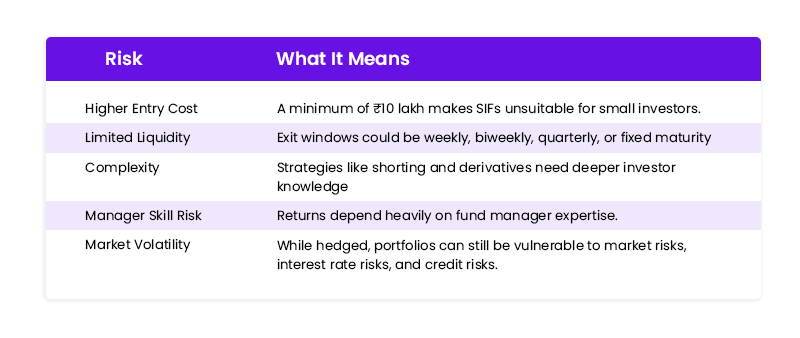
Risk & Limitations
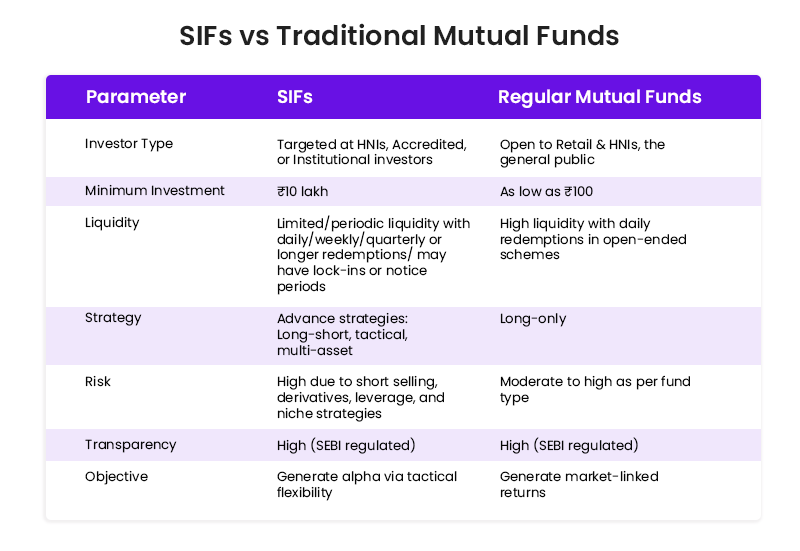
SIFs vs Traditional Mutual Funds
Who Should Invest in SIFs?
SIFs are best suited for:
- High Net-Worth Individuals (HNIs) with high investable surplus
- Seasoned mutual fund investors with deeper experience in markets and various instruments, high risk appetite & market understanding
- Institutional or accredited investors who are well-versed in complex products
- Investors who understand derivatives and market cycles
- Those with a long-term investment horizon of at least 3–5+ years and more.
- SIFs are not meant for beginners or investors seeking high liquidity.
5 Tips Before You Invest in a SIF
- Understand the Strategy:
Don’t get tempted to invest just because SIF is a new product that promises potentially better returns; ensure the fund’s model aligns with your risk tolerance and you understand the underlying investment. - Research the Manager:
SIFs to an extent depend on fund manager’s expertise in executing complex strategies; therefore, research fund managers’ credentials for proven expertise in derivatives and tactical investing. - Know the Liquidity Rules:
Always check redemption frequency and exit load before investing to ensure they align with your time horizon. - Diversify:
Consider splitting your SIF allocation across equity, hybrid, and debt strategies. - Stay Invested for the Long Term:
Strategic funds require a long time horizon of at least 3-5 years.
Illustrative Example
You invest ₹10 lakh in a Hybrid Long-Short SIF. Here’s what might happen:
- The manager goes long on banking and short on overvalued mid-caps.
- The fund also holds bonds for stability.
- If markets stay volatile, the fund may still generate returns by balancing both sides.
This structure offers a smoother ride than pure equity funds in turbulent phases.
Conclusion: A Smart Middle Ground
The Specialised Investment Fund is one of SEBI’s most forward-thinking initiatives yet.
It offers mutual fund transparency with PMS-style strategy depth, creating a new path for sophisticated investors.
SIFs aren’t replacements for mutual funds; they’re an evolution. They cater to investors who want diversified, flexible, and tactically managed portfolios, yet within the comfort of SEBI’s oversight.
If you’re a serious investor looking to enhance your portfolio’s sophistication, SIFs could be your next smart move, provided you understand the risks and stay invested long enough for the strategy to play out.
Become a Mutual Fund Distributor with AssetPlus Academy’s free NISM V-A training and handholding through the entire process. AssetPlus is not just a digital wealth tech platform; it is your growth partner that empowers you to scale your business with end-to-end operations, backend support, marketing knowledge, market, product & sales training, investor education, and more.
FAQs
1. What is the minimum investment for SIFs?
₹10 lakh per investor per AMC.
2. Who can invest in SIFs?
HNIs, accredited investors, and institutional investors.
3. Are SIFs risky?
Yes, they involve advanced strategies and are meant for experienced investors.
4. Are SIFs open-ended?
Some are open-ended, others are interval-based, and redemptions may need notice.
5. Can I invest via SIP?
Yes, but total SIP contributions must reach ₹10 lakh.
Related posts
.png)
.png)
.png)
Become a Mutual Fund Distributor
Build a thriving career as a Mutual Fund Distributor with AssetPlus Academy’s expert-led training and mentorship.

