.jpg)
Time Value of Money
How Understanding Time Value of Money Can Transform Your Investing Outcomes
Imagine this.
It’s 2004, and you are planning to buy a house after 20 years as part of your long-term financial planning in India. At that time, property prices allow you to purchase a 1500 sq. ft. flat in a metro city for around ₹25–35 lakh. It feels like a significant financial goal, but still achievable with disciplined savings and investment planning.
Fast forward 20 years. That same property now costs ₹1.5 crore or more.
Back then, accumulating ₹1 crore seemed like a major milestone, something that could comfortably fund a home purchase and even provide retirement security. Today, however, ₹1 crore is often not enough to buy a house in a metro city, and it certainly may not sustain a comfortable retirement in today’s inflation-driven economy.
What changed? Time, and more importantly, the Time Value of Money (TVM) and the impact of inflation on purchasing power.
What Is the Time Value of Money (TVM)?
The Time Value of Money (TVM) is one of the most fundamental concepts in personal finance and investing in India. It simply states that: A sum of money today is worth more than the same amount in the future. This is not just a theoretical concept, it has real-world implications for every financial decision you make, whether it’s saving, investing, or long-term wealth creation.
In simple terms, ₹10 lakh today holds significantly more value than ₹10 lakh received 10 or 20 years later, because the purchasing power of money declines over time due to inflation. Three key forces drive the Time Value of Money. Understanding these can completely change how you approach investment planning, wealth creation, and financial planning in India.
1. Inflation: The Silent Wealth Destroyer
Inflation refers to the gradual increase in the prices of goods and services over time. As inflation rises, the same amount of money buys fewer goods than it did before.
For example, something that costs ₹1 lakh today may cost ₹2–3 lakh in the future due to inflation. This means that if your money is not growing at a rate higher than inflation, your actual purchasing power is declining. In simple words, inflation quietly erodes your wealth without you even realizing it, making it a major risk in long-term investing and retirement planning.
2. Opportunity Cost: The Cost of Not Investing
Opportunity cost is the benefit you miss out on when you choose one option over another. When you hold money without investing it, you lose the opportunity to earn returns. That same money, if invested wisely in mutual funds, SIPs, or other investment options, could grow significantly over time through compounding.
For instance, ₹1 lakh invested today at a reasonable return could multiply several times over a few decades. But if you delay investing, that growth opportunity is permanently lost. This clearly highlights the importance of investing early and starting SIP investments early in life.
3. Uncertainty and Risk: The Future Is Never Guaranteed
The future is unpredictable. Economic conditions, market movements, and personal circumstances can all change over time. Having money today gives you certainty, flexibility, and control. Waiting for the future introduces uncertainty, where the same amount of money may not hold the same value or utility in terms of future value of money.
The Biggest Mistake Investors Make in Financial Planning
Despite understanding these concepts intellectually, many investors fail to apply them in real life.
They often:
- Set financial goals based on today’s prices without adjusting for inflation
- Underestimate how much money they will actually need in the future
- Delay investing, assuming they can “catch up later”
This leads to a significant gap between expectations and reality when financial goals arrive. The result? Financial stress, compromised goals, or the need to invest aggressively later in life, hurting overall wealth creation strategies.
Time + Compounding: The Real Engine of Wealth Creation
At the heart of the Time Value of Money lies one powerful force: compounding. Compounding is the process by which your investment generates returns, and those returns are reinvested to generate even more returns. Over time, this creates a snowball effect, where wealth grows at an accelerating pace and demonstrates the power of compounding in investing.
The mathematical formula is:
Future Value = Present Value × (1 + r)ⁿ
Where:
r is the rate of return
n is the number of years
The key takeaway isn’t the formula, it’s this: Time (n) has an exponential impact, not linear.
Example 1: Lump Sum Investment – The Power of Starting Early
Let’s understand the impact of time with a simple example.
Investment: ₹1,00,000
Expected return: 10% annually
If you invest this amount for 25 years, it grows to approximately ₹10.8 lakh.
However, if you delay your investment by just 5 years and invest for only 20 years, the final value becomes around ₹6.7 lakh.
This means a delay of just 5 years results in a loss of more than ₹4 lakh. This loss is not due to poor investment decisions or lower returns, it is purely the cost of waiting and delaying investments.
Example 2: SIP Investment Benefits – Small Amounts, Big Impact
Now let’s look at the impact of disciplined investing through a Systematic Investment Plan (SIP), one of the most popular investment strategies in India.
Monthly SIP: ₹5,000
Expected return: 12% annually
If you start early and invest consistently for 25 years:
Total investment: ₹15 lakh
Final value: approximately ₹95 lakh
If you delay by 5 years and invest for only 20 years:
Total investment: ₹12 lakh
Final value: approximately ₹50 lakh
A relatively small difference in investment amount leads to a massive gap in wealth creation. This clearly shows that time matters more than the amount invested in SIP investing and mutual fund investments.
Example 3: Compounding in Long-Term Investing
One of the most misunderstood aspects of investing is how compounding actually works over time.
In the initial years, growth appears slow and almost insignificant. This often discourages investors and leads them to stop investing prematurely.
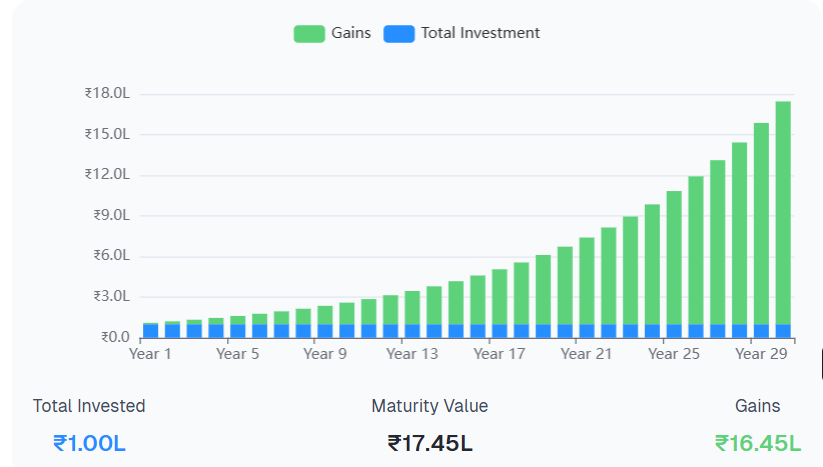
If you invest ₹1,00,000 at 10%:
- After 10 years → ~₹2.6 lakh
- After 20 years → ~₹6.7 lakh
- After 30 years → ~₹17.4 lakh
Notice this:
- Most wealth is created in the later years
- Growth accelerates dramatically over time
This means that delaying your investment doesn’t just reduce returns, it eliminates the most powerful phase of compounding returns and long-term wealth creation.
Inflation: The Invisible Enemy of Wealth Creation
Inflation works quietly in the background but has a profound impact on your finances.
At an average inflation rate of 6%:
₹1,00,000 today is worth about ₹55,000 in 12 years
₹1,00,000 today is worth about ₹30,000 in 20 years
This highlights a critical point:
If your investments are not growing faster than inflation, your real wealth is actually shrinking. Even though your money may appear to be increasing numerically, its real purchasing power is declining due to inflation impact on savings.
Why Saving Alone Is Not Enough
Many individuals believe that consistently saving money is sufficient to achieve financial security. While saving is important, it is not enough because:
- Savings typically earn low returns
- Inflation reduces the real value of saved money
- Long-term goals require growth, not just preservation
To truly build wealth, your money must work for you through smart investing, SIP investments, and diversified investment planning.
A Powerful Mindset Shift in Investing
Most investors focus on the question: “What return will I get?” However, a more powerful and practical question is: “How long will my money stay invested?” This shift in thinking changes everything and reinforces the importance of investment horizon in wealth creation. Returns may fluctuate in the short term, but time allows compounding to work its magic and smooth out volatility.
What This Means for MFDs
For Mutual Fund Distributors (MFDs), the Time Value of Money is one of the most effective tools for client communication. Instead of focusing only on returns, you can:
- Demonstrate the cost of delaying investments
- Show real-life comparisons between early and late investing
- Incorporate inflation-adjusted projections into financial planning
When clients clearly see the long-term impact of time, they are more likely to take action and stay committed to their investments and wealth creation journey.
Final Thoughts: Time Is Your Biggest Wealth Multiplier
The Time Value of Money is not just a concept, it is a reality that influences every financial decision you make. You may not be able to control market conditions or guarantee returns, but you can control two critical factors:
- When you start investing
- How long you remain invested
These two decisions can have a profound impact on your financial future and overall wealth creation and financial planning success. Wealth is not built overnight. It is built gradually, through discipline, patience, and time. Because ultimately: Time is the most powerful multiplier of money.
FAQs
1. What is the Time Value of Money (TVM)?
Time Value of Money means that money today is worth more than the same amount in the future due to inflation and earning potential.
2. Why is ₹1 crore today not equal in value in the future?
Because inflation reduces purchasing power, ₹1 crore today will buy less in the future unless it is invested and grows.
3. How does compounding help in wealth creation?
Compounding helps your money grow faster by earning returns on both your initial investment and the returns already earned.
4. What is the impact of inflation on investments?
Inflation reduces the real value of money, so your investments must grow faster than inflation to increase your wealth.
5. Why is it important to start investing early?
Starting early gives your money more time to grow through compounding, leading to higher wealth with lower effort.
.png)

.png)
Become a Mutual Fund Distributor
Build a thriving career as a Mutual Fund Distributor with AssetPlus Academy’s expert-led training and mentorship.

