What Does CAGR Mean?
When you explore mutual fund returns, you’ll frequently hear about different return metrics. CAGR is the most commonly used metric.
When it comes to evaluating mutual fund performance, investors often get confused by short-term volatility, fluctuating NAVs, and inconsistent point-to-point returns. This is exactly why two metrics dominate investment conversations: CAGR. Let’s simplify CAGR in the most practical way.
What is compounding?
To understand CAGR, let us go over the concept of compounding. Compounding means that the principal amount of your investment earns interest and along with this, the interest accrued on principal also earns interest. When interest/return remains invested it continues to earn interest and overall return compounds in the long run.
What is CAGR?
CAGR (Compounded Annual Growth Rate) shows how much your investments grew each year on a average, over a specific time period. CAGR compounds the return and assumes no further investments, no withdrawals and uniform compounding continuing between the two points in time taken for calculation.
Even if actual yearly returns fluctuated wildly, CAGR smoothens them into a single understandable number.
This is why it is often called the true long-term performance indicator.
For example, assume you invested Rs 1,00,000 in Feb 2013, and it grew to Rs 3,00,000 by Feb 2023.
The CAGR will be calculated as per the formula:
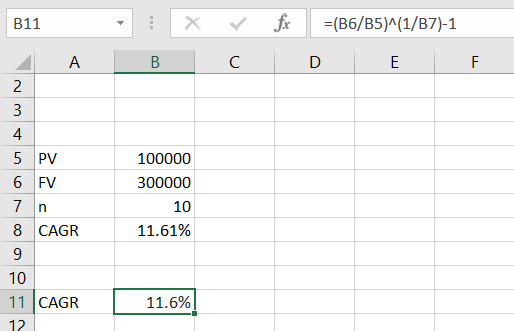
CAGR =(Ending Value/Starting Value)^(1/Number of Years))-1
FV = Ending Value
PV = Starting Value
n= time period in years
You need not calculate CAGR manually; there are CAGR calculators you can use online. Simply input these values, and you’ll get CAGR.
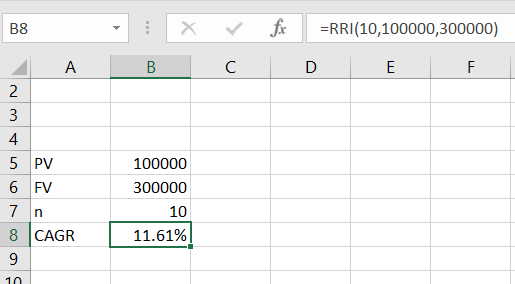
In the above example, CAGR = 11.61%
This means the investment has approximately given you a compound annual return of 11.61% This does not mean every year gave 11.61%. Some years may have been +20%, some -5%. CAGR smoothens them into one figure. CAGR is useful to compare returns across competing investments or schemes over the long term, especially when investment values fluctuate due to market movements.
Why CAGR Matters So Much
1. Smooths Out Volatility
Markets never move in a straight line. CAGR makes long-term returns easier to understand, it is helpful for long tenure investments.
When your investment tenure is more than one year, you still need an yearly return overview, CAGR is the metric used.
2. Great for Comparing Mutual Funds
Want to compare two large-cap funds over 5 years? CAGR is the most objective metric.
3. Useful Across Asset Classes
Whether you want to compare your fixed deposit with equity, gold with stock markets or mutual funds with ULIPs, CAGR makes cross-category comparison fair and simple, and givers you an overall performance view without complex calculations.
4. Eliminates Timing Bias
Unlike point-to-point returns, which depend on start and end dates, CAGR gives a true performance picture. CAGR is not useful when there are intervening inflows or withdrawals, periodic actions such as SIPs or SWPs during the investment tenure.
CAGR vs. Absolute Return
As an MFD or investor, you must have often come across the term 'Absolute Return'. Simply put, absolute return does not take time period in account, it is not annualised return but actual return between one point to the other.
In the example taken before, the Absolute Return is: (FV-PV)/PV = 200000/100000 = 50%
Absolute return is a blind calculation to see bare return over principal. It cannot be used for comparison if the investment tenure is different. E.g. Absolute return of 50% over 10 years is very different from Absolute return of 50% over 3 years!
Therefore, CAGR is a more accurate metric to assess and compare performance.
How to Calculate CAGR Yourself (Easily)
1. Online Lumpsum Calculators
You can easily calculate CAGR within seconds using online calculators available on numerous websites.
2.Excel Sheet Formulas
To cement this concept, you can easily calculate the CAGR yourself using Excel or Google Sheets.
a) Add Starting Value, Ending Value, and Time in a single column.
b) Go to the Formula tab in Excel, check ‘financial’ and scroll down to the RRI formula.
c) In a cell, type =RRi and add values for Fv (Future value), Pv (Present value), nper (time), and add % to the final value.
d) Alternatively, copy and paste the CAGR formula in a cell, enter values, and calculate.
A Quick Nerd Note
Let’s go one step further to better understand how the CAGR formula is derived.
We all know the basic formula for calculating compound interest:
A= P(1+r/100)^n
(where A = Ending Value, P=Starting value, r = rate of interest, n = time period)
From this, we can say
A-P = (1+r/100)^n
(A-P)^1/n = 1+r/100
r/100 = (A-P)^1/n - 1
r% = (A-P)^1/n - 1
CAGR = (A-P)^1/n - 1
You need not worry about calculating CAGR manually. You can easily access CAGR calculation on the AssetPlus partner app, navigate to Resources section lumpsum calculator.
If you are an existing ARN holder, register on the partner app and explore how you can manage your entire distribution business from client onboarding to accessing client reports, executing transactions in real time, joining webinars, downloading marketing materials, getting regular market updates, and resolving your product queries within seconds.
If you are aspiring to step into a rewarding MFD career but are not sure how to start, AssetPlus Academy helps you through the entire process of attaining NISM V-A certification to gaining your first client and building a successful career.
Want to Become a Mutual Fund Distributor?
If you’re aspiring to build a career as an MFD, AssetPlus Academy offers complete guidance:
✓ NISM V-A exam preparation
✓ Expert-led training sessions
✓ Step-by-step support for registration
✓ Business growth & product training
✓ Personalized mentorship
✓ Dedicated Relationship Manager
From clearing the exam to signing your first client, you grow with a partner supporting you at every stage. Register Now.
Related posts
.png)
.png)
.png)
Become a Mutual Fund Distributor
Build a thriving career as a Mutual Fund Distributor with AssetPlus Academy’s expert-led training and mentorship.

