
What is XIRR in Mutual Funds?
As Mutual Fund Distributors (MFDs), we discuss mutual fund returns with investors on a daily basis. Questions around SIP returns, portfolio performance, and long-term growth are common.
When investors invest in mutual funds, they naturally want to track performance and compare it with other investment options. These comparisons often drive decisions such as continuing SIPs, switching schemes, or rebalancing portfolios. If returns are not presented using appropriate metrics, investors may misjudge performance.
For MFDs, having clarity on mutual fund return calculation methods is essential to guide investors. In this blog, let’s discuss XIRR, a key return metric for mutual funds.
Why CAGR is Not Suitable for SIPs and Real-Life Investing
CAGR, or Compounded Annual Growth Rate, is one of the most commonly used metrics to measure mutual fund returns. It works well when an investment is made as a single lump sum and redeemed at one future date, with no cash inflows or outflows in between. In such cases, CAGR provides a clean annualised return figure that is easy to understand and compare.
However, most investors do not invest this way. SIPs involve investments made on multiple dates, with varying amounts and changing market conditions. Investors may also add lump sums, skip SIP installments, or make partial withdrawals. In these real-life scenarios, CAGR fails to capture the true performance of investments, making it unsuitable for return calculations.
What is XIRR and How It Works in Mutual Funds
XIRR stands for Extended Internal Rate of Return. It is a return metric designed to calculate annualised returns when multiple cash flows occur on different dates. XIRR considers the exact investment amounts, precise transaction dates, and all inflows and outflows during the investment period.
Because of this, XIRR provides a realistic and accurate picture of how an investor’s money has actually performed. It converts complex cash flows into a single annualised return, making it the most reliable metric for evaluating SIPs, SWPs, and portfolios with multiple investments.
When Should MFDs Use XIRR Instead of CAGR?
XIRR should be used whenever there are multiple investments or withdrawals during the investment tenure. This includes SIPs, SWPs, portfolios with staggered lump-sum investments, and cases involving partial redemptions. In simple terms, if money moves more than once, XIRR is the correct return metric.
Using XIRR helps eliminate timing bias and reflects real investor behaviour. It ensures that performance evaluation is based on how money was actually invested, not on simplified assumptions.
How to Calculate XIRR in Excel
Calculating XIRR is simple and practical for MFDs.
- List all your transactions (investments & withdrawals) with dates.
- Add investments as negative values (add a minus prefix).
- Add withdrawals as positive values.
- Add date next to each transaction (in 01 Apr 2025 format).
- Use the XIRR formula (values, dates) (image below).
- The resulting percentage represents the annualised return on investment
Let’s take an example to understand the concept better.
Suppose you invested ₹10 lakh on 1 Jan 2020 and redeemed a sum of ₹12 lakhs in Jan 2025. Calculating return is easy here; you can directly compute the CAGR for this investment.
But real-life investing is rarely this simple.
What if you:
- Invested ₹50,000 every month starting 1 Jan 2020
- Added ₹1,00,000 in April
- Invested another ₹50,000 in 2021
- Put in just ₹40,000 in 2022
- Invested ₹50,000 in 2024
- Redeemed all your investment in 2025
Now the cash flows are:
- At irregular intervals
- Of different amounts
- May include some withdrawal in between, in real life scenario
- Return can be easily calculated in Excel (See image below)
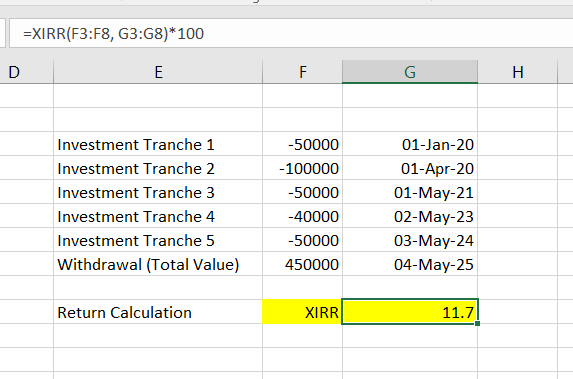
This method is especially useful for explaining SIP returns to investors, as it aligns return calculation with actual cash flows.
Why XIRR Matters for Mutual Fund Investors
XIRR plays a crucial role in helping investors assess whether their investment strategy is working. An investor may expect a certain return based on market performance or peer fund comparisons. However, if the XIRR of their portfolio is lower than expected, it signals the need for review or rebalancing.
By using XIRR, investors can identify underperformance early and take corrective action. Without XIRR, such insights are often missed, leading to delayed decision-making.
Why Understanding XIRR Builds MFD Credibility
For Mutual Fund Distributors, the ability to explain XIRR clearly strengthens investor trust. It helps set realistic expectations, improves transparency, and reduces confusion around return figures. An MFD who understands and communicates XIRR effectively is seen as a knowledgeable advisor rather than just a product seller.
In an environment where investors are increasingly informed, mastering XIRR is a key differentiator for MFDs.
Conclusion: XIRR is the Most Accurate Return Metric for SIPs
While CAGR remains useful for simple lump-sum investments, it does not reflect real-life investing patterns. XIRR is the most accurate way to measure SIP returns and portfolio performance. It captures real investor behaviour and provides a true picture of long-term returns.
For Mutual Fund Distributors, understanding XIRR is no longer optional. It is a core advisory skill that leads to better investor communication, improved decision-making, and stronger long-term relationships.
Want to Become a Mutual Fund Distributor?
If you’re aspiring to build a career as an MFD, AssetPlus Academy offers complete guidance at every step:
✓ Expert-led training sessions
✓ Step-by-step support for registration
✓ Business growth & product training
✓ Personalized mentorship
✓ Dedicated Relationship Manager
From clearing the exam to signing your first client, you grow with a partner supporting you at every stage. Register Now.
Related posts
.png)
.png)
.png)
Become a Mutual Fund Distributor
Build a thriving career as a Mutual Fund Distributor with AssetPlus Academy’s expert-led training and mentorship.

