.png)
Why Now Is the Best Time to Become a Mutual Fund Distributor (MFD) In India
India's investment landscape has changed dramatically over the past decade.
Millions of investors have adopted mutual funds, and SIPs have become a household concept. Mutual funds, SIPs, and markets are now finding their way into everyday conversations.
Much of this progress has been supported by a strong distribution network and regulatory push, creating new opportunities for individuals considering a career as a Mutual Fund Distributor (MFD). A recent development suggests that the role of MFDs may continue to evolve.
According to recent reports, SEBI is considering a new category of distributors to encourage greater retail participation in India's debt markets. While the proposal is still under discussion, it reflects a broader trend that has been shaping the financial services industry for some time: bringing more investors and offering wider choices in investments.
A Market With Significant Potential
India's bond market is valued at approximately USD 2.81 trillion (Rs 235-240 lakh crore) as of December 2024. (Source)
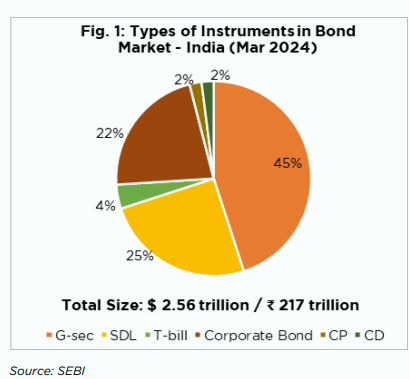
India's corporate bond market has grown substantially and today represents more than ₹58 lakh crore in outstanding issuances. At around ~16% of GDP, this market remains modest compared to developed economies, indicating untapped potential in mobilising long-term capital.
CRISIL projects India's corporate bond market to nearly double to around ₹100 lakh crore by FY2030.
As the country scales up infrastructure and industrial capacity, the demand for diversified fund sources, particularly long-term capital, will rise sharply. A well-developed bond market provides firms with an alternative source of funding, reducing dependence on banks and broadening access to investors.
For retail investors, it provides an alternative to bank deposits with potentially higher returns, channeling household savings into productive use.
So far, India has made good progress in debt mutual funds and has established a strong foundation in bond ETFs. However, despite its size, overall retail participation in debt markets remains relatively limited compared to other investment categories.
The debt market remains elusive to most retail investors as bonds and fixed-income products appear complicated and out of reach. Access, awareness, and understanding continue to be barriers.
As regulators, market participants, and institutions work to address these gaps, distribution is likely to play an important role.
After all, investor participation rarely increases because a product becomes available. Participation grows when investors understand how a product fits into their financial goals and feel comfortable taking the first step.
That is where trusted guidance becomes valuable.
Why Investor Education Matters More Than Ever
As new products and investment avenues emerge, investor education becomes increasingly important.
SEBI has consistently emphasised the need for suitability, transparency, and responsible distribution. The objective is not simply to increase participation, but to ensure that participation is informed and aligned with investor needs.
This creates an important role for distributors and highlights why more professionals are exploring how to become an MFD in India and participate in the country's growing investment ecosystem. Investors often have access to information, but they want to understand risks, time horizons, expected outcomes, and how different products fit within their broader financial plans.
Ultimately, investors look for an expert opinion to make confident financial decisions without apprehension. Helping investors make sense of these decisions is where meaningful value is created.
What This Could Mean for MFDs
For existing and aspiring Mutual Fund Distributors, the development is great news because it signals the continued expansion of India's investment ecosystem and strengthens the long-term potential of the mutual fund distribution business in India.
Over the years, the scope of products available through distribution channels has steadily widened. The introduction of Specialized Investment Funds (SIFs) is one example. Increased focus on debt products and bond-market participation will further expand the product suite.
The expanding product portfolio meets the varied financial needs of investors, creating opportunities for MFDs to build a more comprehensive and sustainable MFD business by serving investors across multiple asset classes. MFDs equipped with the right certification and knowledge can offer one-stop service and level up from distribution to financial guidance, a true differentiator in this business.
For MFDs, this creates opportunities to deepen client relationships and build a scalable mutual fund distribution business by serving investors across a broader range of financial needs over time.
Looking Ahead
The proposal relating to debt-market distribution is still evolving, and it may take time before the final framework becomes clear.
Even so, the direction is significant. India's financial markets are becoming broader, more accessible, and increasingly inclusive. As this continues, the need for informed, responsible, and investor-focused distribution is likely to grow.
For those considering a career in mutual fund distribution in India, the opportunity today extends beyond a single product category. It is increasingly about building a long-term career in mutual fund distribution within a rapidly expanding financial ecosystem.
And in an industry built on trust, education, and long-term relationships, those fundamentals remain as relevant as ever.
AssetPlus Academy helps you take the first confident step towards becoming a Mutual Fund Distributor in India. Right from NISM registration to expert-led NISM V-A certification training, ARN assistance, and a tech platform to set up and grow your MFD business, you have a growth partner in AssetPlus. To know more about our training programs, click here.
Valueplus Technologies Pvt. Ltd. (AssetPlus)
AMFI Registered MF Distributor | ARN-114376
FAQs
1. How do I become a Mutual Fund Distributor in India?
The process typically involves clearing the NISM Series V-A certification, obtaining an AMFI Registration Number (ARN), and partnering with a platform that supports business setup and operations.
2. Is prior experience in finance required to become an MFD?
No. Prior financial experience is not mandatory. Individuals from diverse professional backgrounds can build a career in mutual fund distribution by gaining the required knowledge and certification.
3. Why is now a good time to become an MFD in India?
India's investor base is expanding rapidly, financial products are becoming more diverse, and there is a growing need for investor education and guidance, creating significant opportunities for MFDs.
4. What role do MFDs play beyond selling mutual funds?
MFDs help investors understand financial products, evaluate risks, align investments with financial goals, and make informed long-term investment decisions.
5. How can AssetPlus Academy help aspiring MFDs?
AssetPlus Academy supports aspiring MFDs with expert-led NISM V-A certification training, ARN assistance, and technology solutions to help them start and grow their mutual fund distribution business.
Related posts
.png)

.png)
Become a Mutual Fund Distributor
Build a thriving career as a Mutual Fund Distributor with AssetPlus Academy’s expert-led training and mentorship.

