
Women, Wealth and the Opportunity for Change
Women and Investing in India
Meet Nisha.
An engineer and IT executive earning a lucrative salary, she has carefully planned her life. Independent, educated, and professionally successful, she represents a generation that has come a long way from her mother’s time.
Her days run like clockwork as she balances career goals, family responsibilities and personal ambitions. Yet one aspect quietly slips through the cracks - her financial well-being. Money comes in regularly. Salaries, bonuses, and increments arrive on schedule. She spends carefully, saves diligently, and plans her taxes. Years ago, she even started a few SIP investments in mutual funds and built a small stock portfolio on a friend’s suggestion. But her financial life remains largely passive, with little monitoring, review or long-term planning.
Then came 2020. When the pandemic struck and markets plunged, uncertainty was everywhere. During a conversation, a friend suggested withdrawing investments and holding cash until things stabilized. “What if markets fall further? What if the economy collapses?” The fear got to her.
She redeemed her mutual funds, stopped her SIPs, and parked money in a savings account. In the chaos of the pandemic, even the thought of finding better options faded away. For the next three years, her money simply sat idle. When life returned to normal, she considered investing again. But by then, markets had recovered strongly, while her investments had not. She had lost time, momentum, and confidence. Nisha’s story is not fictional. It reflects the experience of millions of investors, particularly women, during the pandemic years. Lack of focus, no investment planning for wealth creation, and no guidance. Ironically, it is not about lack of money but a lack of professional guidance and support.
The Hidden Gap in Women's Financial Planning
Traditionally, women investors tend to be more cautious with money.
They often:
- Avoid taking financial risks
- Focus more on saving than investing
- Seek external validation before making financial decisions
- Prioritize well being of others over themselves, family responsibilities over their own financial planning
This may not be true for everyone, but it is more common than not. Even highly educated, financially independent women can find themselves under-invested or disengaged from their finances. The result? Money is saved but not optimized. This creates a gap in women wealth management and financial independence.
A Silent Financial Revolution Underway
Despite these challenges, a powerful shift is happening in women financial empowerment in India. Women are increasingly participating in the workforce, earning, saving and making financial decisions. At a ground level, there is an increasing adoption of financial products, SIPs and mutual fund investments.
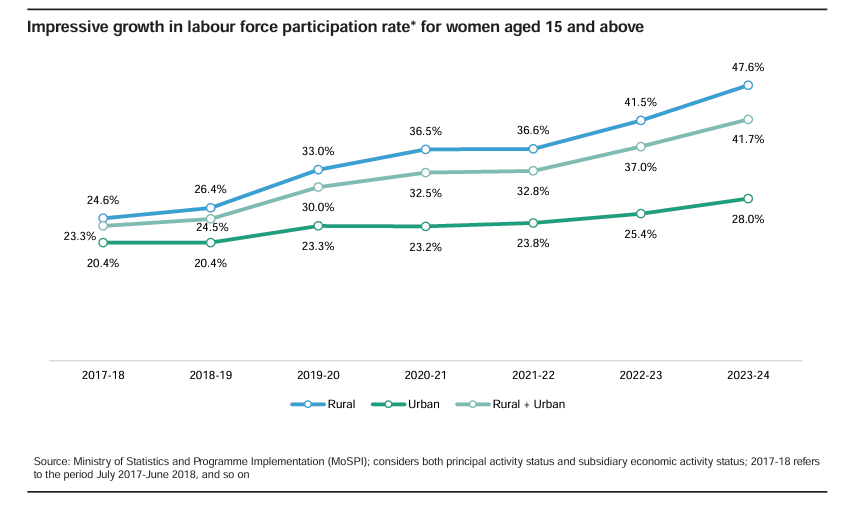
According to government data, women’s labour force participation increased from 23.3% in 2017-18 to 41.7% in 2023-24. Education, financial awareness and economic opportunities have brought more women into the workforce and expanded their role in household financial decision-making.
Data Source: https://www.amfiindia.com/Themes/Theme1/downloads/AMFI_womensDay_Mar2024.pdf
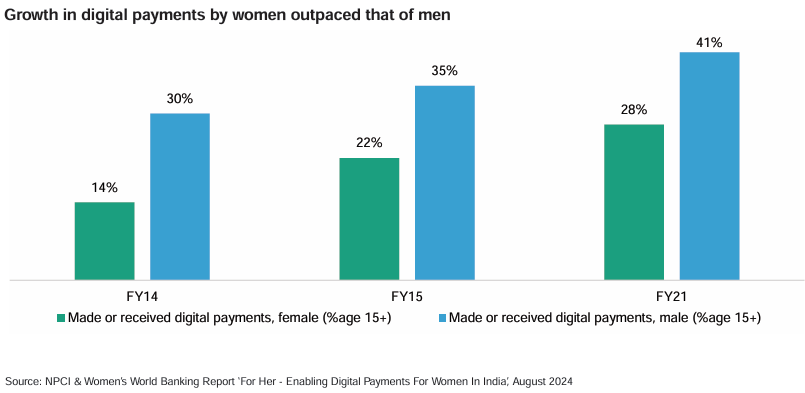
More women now have their own savings accounts, reflecting growing financial autonomy. The digital revolution has also accelerated this change. With smartphones and digital banking, women are managing payments, banking, and investments independently. In fact, the growth in digital payments by women has outpaced that of men, signalling a new era of financial participation. This reflects expanding financial inclusion for women across India.
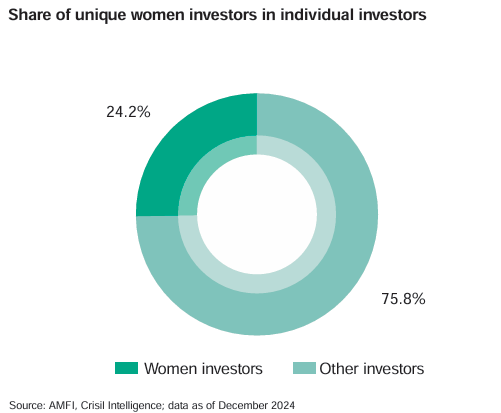
One in four unique individual investors in mutual funds is a woman. As of December 2024, women accounted for one in every four MF investors, underscoring the growing trend of women’s empowerment in financial decision-making. Women investors’ adoption of MFs in India has surged over the past five years. This marks a strong evolution in women investment trends in India. The mutual fund industry reflects this transformation:
- One in four individual mutual fund investors is now a woman.
- Women investors’ AUM more than doubled from ₹4.59 lakh crore in March 2019 to ₹11.25 lakh crore in March 2024.
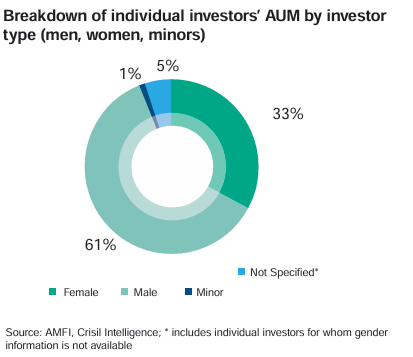
- Women now account for roughly ₹33 out of every ₹100 invested in mutual funds by individuals.
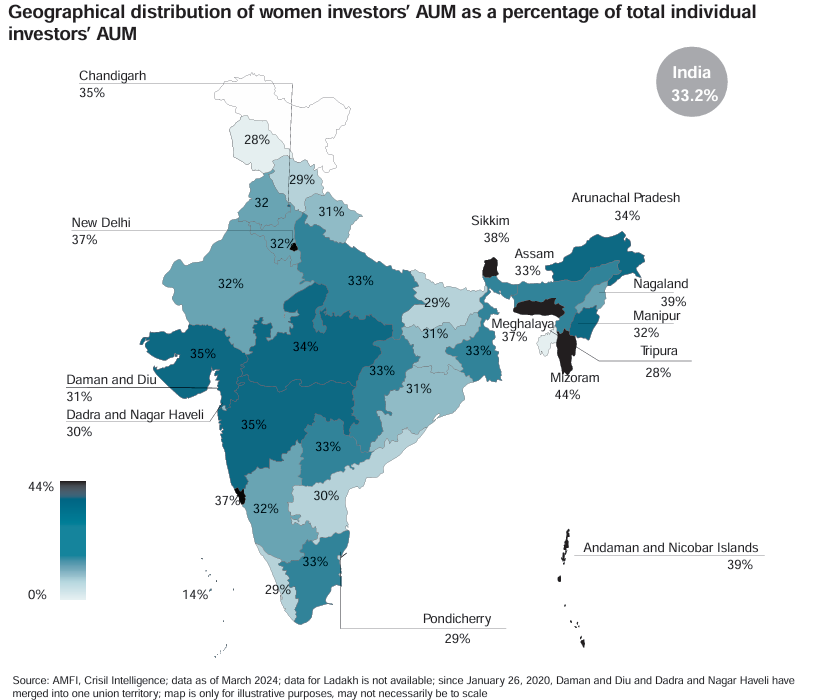
The shift is not limited to large cities. Women investors in T30 cities account for nearly 74.8% of women investors’ AUM, but participation from B30 cities has steadily increased from 20.1% in 2019 to 25.2% in 2024, indicating growing adoption of mutual funds by women investors across India.
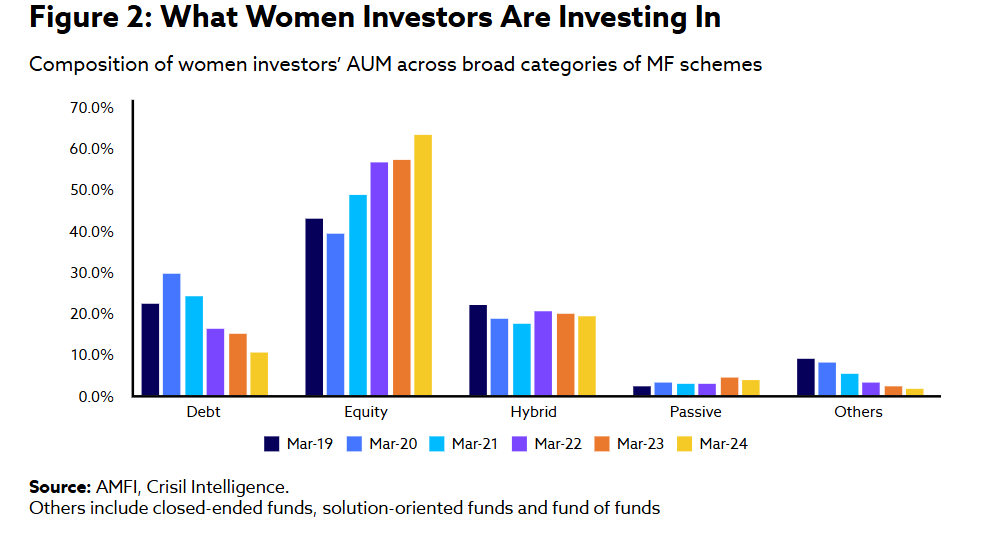
Investment behaviour is also evolving. The share of equity in women investors’ portfolios increased from 43.3% in 2019 to 63.7% in 2024, showing greater comfort with long-term growth assets. This shift strengthens the case for mutual funds for women investors as a powerful wealth-building tool.
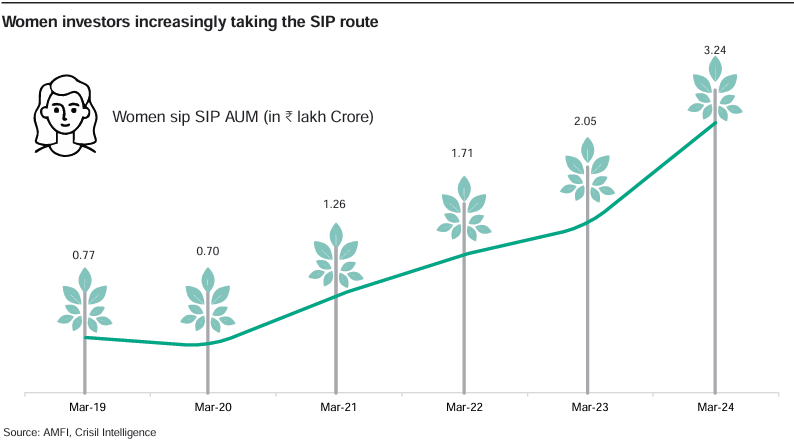
SIPs are also gaining popularity. Women’s SIP AUM accounted for over 30.5% of total SIP AUM in March 2024 and grew by over 319% between 2019 and 2024. This data confirms the fact that women investors are steady in their financial habits and with the right guidance more women can turn their saving habits into disciplined long term wealth creation process.
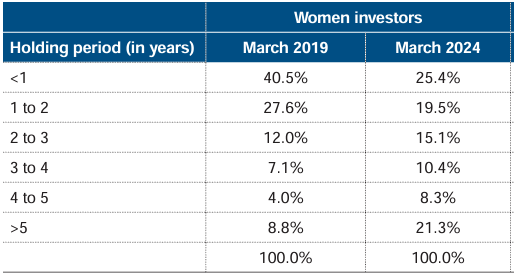
Even more encouraging is the shift toward long-term investing. The proportion of women investors holding investments for more than five years increased from 8.8% in 2019 to 21.3% in 2024. All these trends point to a clear reality: India is witnessing a silent financial revolution led by women.
Why Women Are Powerful Long-Term Investors
Interestingly, studies consistently show that women often make excellent long-term investors. They tend to invest with clear financial goals, trade less frequently, remain disciplined with long-term plans, and focus on wealth creation rather than speculation. These unique facets often lead to better long-term investment outcomes. But they still face one major hurdle: Confidence.
The Role of Mutual Fund Distributors
This is where Mutual Fund Distributors (MFDs) have a powerful role to play. Behind every hesitant investor like Nisha lies an opportunity. It is not just about selling a financial product, but to handhold women investors in their financial planning journey & build financial confidence.
Women investors often value:
- Ethical guidance they can trust
- Clear explanations of risks and returns
- Long-term planning aligned with life goals
- Regular reviews and reassurance during market volatility
An empathetic, knowledgeable MFD can bridge the gap between saving and wealth creation. Women have unique financial journeys where career, income, financial goals and journeys can be different, thus requiring clear understanding and goal planning for unique life situations.
Career breaks, maternity, income gaps, second careers, family members' involvement in financial decisions etc require MFDs to design flexible investment strategies, adjust plans during transition and provide empathetic support to not abandon the long term goals during such times.
Another challenge is to build financial confidence through education, awareness and interest building, providing reassurance during market volatility and regular communication to help women investors stay committed to financial planning.
Recently, regulator SEBI announced additional incentive of up to Rs.2000 to MFDs for bringing in new women investors (new PAN) from B30 and T30 cities. For lumpsum investments, There is additional incentive of 1% for first the first application with a cap of Rs 2000 per investor (investor must remain invested for minimum one year). For SIP, 1% additional commission is paid on first year's SIP contribution with a cap of Rs 2000 and investor staying invested for minimum one year.
These incentives further emphasise the growing demand and need for financial inclusion for women across the country and to encourage MFDs to extend reach of wealth creation tools to women investors across India.
A Career Opportunity for Women MFDs
There is another dimension to this story.
Women do not just represent a growing investor base; they are also an untapped force within the financial advisory profession. And who better to guide a woman investor than another woman, who may better understand her financial priorities and life goals? The number of women distributors had touched 37,376 registrations as of December 2024. This represents 21.5% of the total registered MFDs in India.
Mutual Fund Distribution has wide scope in the country with less than 4% of population investing in mutual funds and growing awareness about financial planning and mutual funds in big and small cities. Mutual Fund Distribution can be an empowering path for women returning from career breaks, women looking for flexible and meaningful careers, women looking for long term entrepreneurial opportunities without any huge upfront investment and women looking to upskill themselves in the digital and knowledge based world.
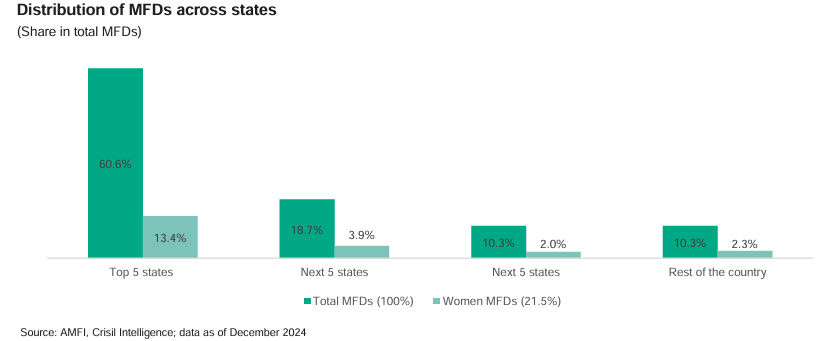
In short, MFD is a lucrative career for many women seeking:
- Flexible working hours
- A meaningful career
- The opportunity to build financial independence
- The ability to help other women succeed financially
While the path is clear, direction is not. This is where initiatives like MFDisha by AssetPlus Academy aim to make a difference. MFDisha is designed to bring more women into the world of wealth creation and financial leadership, enabling them to build meaningful careers in mutual fund distribution while helping others make better financial decisions. If you are ready to take that step, explore the MF Disha with AssetPlus Academy here and start building your journey toward financial independence.
Your opportunity to lead in finance could begin today.
Related posts
.png)

.png)
Become a Mutual Fund Distributor
Build a thriving career as a Mutual Fund Distributor with AssetPlus Academy’s expert-led training and mentorship.

