.png)
Understanding IRR - Internal Rate of Return
You must have heard the term IRR in investments, projects, businesses, etc. Let us understand what IRR means in simple terms and where it is practically useful. Any new project, business, or investment requires the owner or investor to do a simple cost-benefit analysis. To determine any project’s viability, the Internal Rate of Return should be higher than the expected rate of return.
IRR is useful when the cash flows accrue yearly, and an annual growth rate is required to assess overall project/investment profitability.
When evaluating an investment, most people ask:
“How much profit will I make?”
Smart investors ask:
“At what annual rate is my money actually growing?”
That’s exactly what the Internal Rate of Return (IRR) helps you measure.
What is IRR?
Internal Rate of Return (IRR) is the annual percentage return at which the present value of all future cash flows equals the initial investment.
In technical terms, it is the discount rate that makes the Net Present Value (NPV) of all future.
Example:
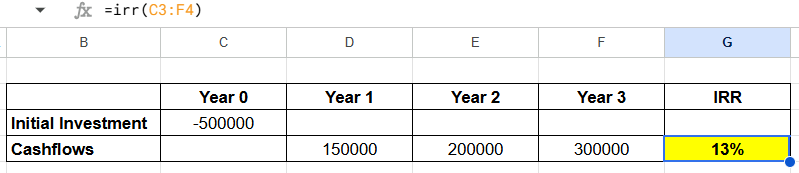
Here is a simple example of an IRR analysis where cash flows are assumed to be annual. Assume that you invest ₹5,00,000 in a small business.
Expected returns from this investment are:
- Year 1: ₹1,50,000
- Year 2: ₹2,00,000
- Year 3: ₹3,00,000
Total cash received = ₹6,50,000. The overall profit is ₹1,50,000. Money received in the future is not the same value as money today because of the time value of money. Hence, comparison is not simple. It is difficult to judge the actual return if you have to compare it with some other investment, say a Fixed Deposit with 6% return, or another business with different cash flows.
You can use Excel for calculating IRR using built-in formulas.
Simply add investment as a negative value and cash flows as positive values.
Add formula =IRR(select values)
But here’s the important part:
When we calculate the IRR for this investment, it may come out to around 13% annually. That means your money effectively grew at about 13% per year over three years.
That’s the real power of IRR; it converts uneven cash flows into a single annual growth rate.
Why Internal Rate of Return (IRR) Matters
The concept of Internal Rate of Return is based on the time value of money, ₹1 today is worth more than ₹1 received in the future.
Since most investments generate returns over time (not in a single lump sum), IRR helps answer:
- Is this project financially viable?
- Is this investment better than a 6% Fixed Deposit?
- Does this opportunity beat my required rate of return?
If IRR > Required Return, the investment is attractive.
If IRR < Required Return, it may not justify the risk.
IRR Real Life Applications
Business & Corporate Finance
Many businesses use IRR to decide whether to:
- Launch a new product
- Set up a new manufacturing plant
- Invest in machinery
- Enter a new market
If IRR > cost of capital → Project is viable.
Startups & Venture Capital
Investors calculate IRR to evaluate:
- Early-stage investments
- Exit returns
- Fund performance
Private equity funds often advertise returns in terms of IRR.
Real Estate
In real estate investments, rental income + resale value are used to compute IRR to evaluate:
- Property investments
- Commercial leasing projects
Personal Investments
You can use IRR (or XIRR) to evaluate:
- SIP returns
- ULIP returns
- Portfolio performance
- Annuities Returns
It gives you the actual annualized return considering the timing of investments and withdrawals. XIRR is useful for calculating returns for non-periodic returns or cashflows.
How to Interpret IRR
Let’s say:
Your required return = 12%
Project IRR = 18%
This means the project generates returns above your minimum expectation, which means, it is financially attractive. If IRR = 8% and your required return = 12%, it may not be worth the risk.
How IRR is Useful for MFDs
For Mutual Fund Distributors, understanding terms such as IRR can significantly improve client communication and portfolio advisory quality. Instead of presenting only absolute returns, MFDs can use XIRR to show the real annualized growth rate of SIPs and staggered investments.
IRR is also useful in goal-based planning, where actual portfolio returns can be compared with a client’s required return, such as 12% for retirement. During portfolio review meetings, IRR enhances credibility by reflecting time-weighted and cash-flow-adjusted performance. It also helps in comparing equity, debt, hybrid funds, and lump sum versus SIP investments as well as returns from other asset classes.
To Conclude,
IRR is not just a finance formula. It is a decision-making tool. It is generally used for capital budgeting analysis and used with other parameters, such as NPV, for accurate analysis. It helps you compare opportunities, allocate capital efficiently, and understand the real growth rate of your money.
If you are an aspiring distributor, join NISM V-A self-study or live training workshops for structured comprehensive learning with industry experts complemented with mock tests, practice questions, live Q&A, study material, all at zero cost. Complete the NISM V-A certification and take the first step towards a successful MFD career that offers stable income, flexbile work from anywhere schedule and an opportunity to help other achieve financial freedom. Register Now and our team will call you for further details.
Frequently Asked Questions (FAQs)
1. What is a good IRR percentage?
A good Internal Rate of Return depends on risk. For many investors, 12–15% is considered strong for equity investments, while 6–8% may be acceptable for low-risk investments.
2. What is the difference between IRR and XIRR?
IRR is used for periodic (annual) cash flows. XIRR is used for irregular cash flows like SIPs and staggered investments.
3. Is higher IRR always better?
Generally yes, but risk must be considered. A higher IRR with high risk may not always be preferable.
4. Can IRR be negative?
Yes. If cash inflows are lower than the initial investment, IRR can be negative.
5. Why do private equity funds show IRR instead of total returns?
Because Internal Rate of Return reflects annualized growth considering timing of cash flows, making it more accurate for long-term investments.
Related posts



Become a Mutual Fund Distributor
Build a thriving career as a Mutual Fund Distributor with AssetPlus Academy’s expert-led training and mentorship.

